
Introduction: The Trillion-Dollar Misconfiguration Problem
In the modern enterprise landscape, cloud object storage services serve as your primary data backbone. For instance, platforms like Amazon Web Services (AWS) S3, Google Cloud Storage (GCP), and Azure Blobs are industry staples. They house your application assets, database logs, financial profiles, and private user documentation securely.
Yet, despite millions of dollars poured into advanced perimeter defenses, critical data breaches continue to dominate the news. Surprisingly, the vast majority of these incidents do not stem from complex zero-day cyber exploits. They also rarely involve sophisticated state-sponsored hacking campaigns. Instead, they occur because of simple configuration oversight.
Consequently, a single misplaced permission checkbox can instantly expose your sensitive database assets to the public internet. Therefore, learning how to audit cloud storage bucket permissions is a foundational pillar of digital security hygiene. This comprehensive guide outlines the exact tactical methodology required to inspect, verify, and lock down your storage resources.
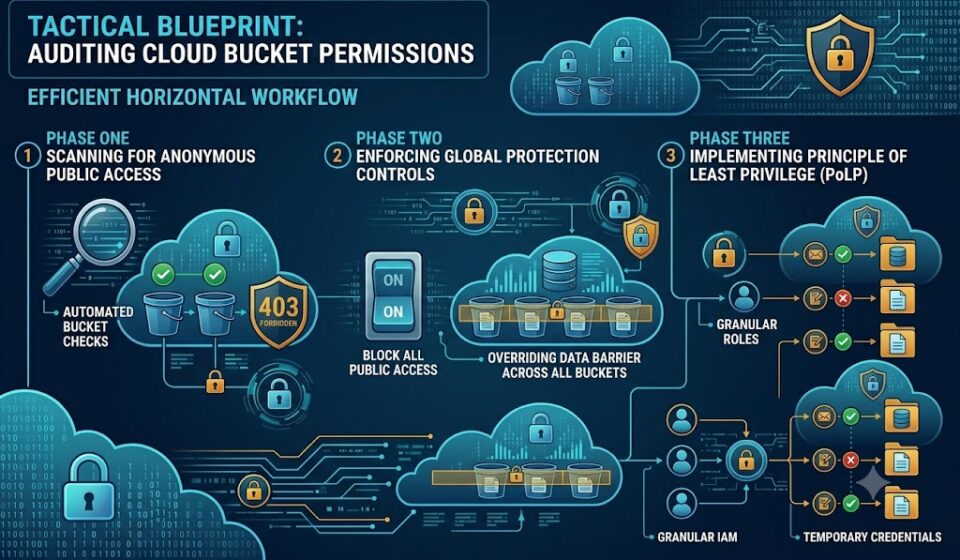
1. Phase One: How to Audit Cloud Storage Bucket Permissions for Anonymous Public Access
The absolute highest priority during any infrastructure security audit is identifying containers that allow unauthenticated public read requests. Therefore, you must learn exactly how to audit cloud storage bucket permissions to find these exposed endpoints. When an asset is mistakenly exposed globally, malicious scraping bots can discover your intellectual property within minutes.
“Cloud security is no longer about configuring complex cryptographic protocols. Instead, it is about establishing a culture of deep visibility. Over 90% of cloud storage data leaks are caused entirely by simple operational mistakes.” – Cloud Infrastructure Protection Manual
Manual vs. Programmatic Verification
While you can click through your cloud provider’s web console, large enterprise environments require a faster approach. Specifically, handling hundreds of separate storage assets requires an automated command-line interface (CLI) strategy to scale properly.
For example, utilizing the AWS CLI, you can run a script to poll your infrastructure instantly. This command outputs the exact Access Control List (ACL) configurations of your target buckets:
# List all buckets and query their public access block configuration status
aws s3api get-public-access-block --bucket your-target-storage-bucket-name
If this command returns an error, your storage assets are actively vulnerable. Thus, they require immediate remediation.
2. Phase Two: Enforcing Absolute Global Protection Controls
To protect your infrastructure from human mistakes, major cloud service providers build out centralized override switches. These rules act as a master barrier that blocks public access account-wide. Consequently, they completely nullify any loose object-level access policies a user might accidentally apply down the line.
[Main Cloud Management Console] ➔ [Storage Architecture Overview] ➔ [Bucket Policies] ➔ [Toggle: Enable Block All Public Access]
Understanding Root Policy Overrides
When you activate a global “Block Public Access” policy, the platform executes an absolute check. This check happens natively at the gateway level. Therefore, even if an application folder contains an explicit policy allowing public access, the master switch overrides it. As a result, the platform drops the connection with a strict 403 Forbidden error.
Unless a bucket explicitly hosts public marketing imagery, this safety switch must remain toggled ON across your network. For a broader look at securing core web frameworks, visit Technology.
3. Phase Three: Implementing the Principle of Least Privilege (PoLP)
An incredibly common security anti-pattern found in corporate structures is the use of overly permissive IAM configurations. Often, developers who only need basic read access are mistakenly granted global administrative capabilities to save setup time.
The Principle of Least Privilege (PoLP) dictates that every user account must only receive minimal access rights. Thus, they get exactly what they need to execute their specific task, and absolutely nothing more.
Transitioning from Core Root Keys to IAM Roles
-
Never Use Global Root Access Keys: Generating permanent root access keys is an extreme security vulnerability. If a malicious entity extracts those keys, they gain absolute control over your entire cloud infrastructure.
-
Leverage Temporary STS Tokens: Utilize temporary Security Token Services (STS). These systems issue short-lived credentials that naturally expire within hours. Consequently, leaked keys become completely useless to an intruder almost immediately.
-
Enforce Granular Resource Policies: Instead of creating a wide policy, explicitly restrict the scope to individual file pathways:
{
    "Version": "2012-10-17",
    "Statement": [
        {
            "Effect": "Allow",
            "Action": [
                "s3:GetObject",
                "s3:PutObject"
            ],
            "Resource": "arn:aws:s3:::your-secure-production-bucket/incoming/*"
        }
    ]
}
4. Platform-Specific Security Tooling Reference
Every major cloud vendor packages specialized internal utilities designed to monitor and alert your team to anomalies. Therefore, utilizing these native frameworks removes the need for complex, third-party software overhead.
| Cloud Platform Ecosystem | Primary Permission Metric | Recommended Security Framework |
| Amazon Web Services (AWS) | S3 Bucket Policies & Object ACLs | AWS IAM Access Analyzer |
| Google Cloud Platform (GCP) | Uniform Bucket-Level Access & IAM | GCP Security Command Center |
| Microsoft Azure | Storage Account Access Toggles | Microsoft Defender for Cloud |
5. Advanced Monitoring: Establishing Continuous Permission Compliance Protocols
Once you establish proper access baselines, you must implement continuous automated tracking mechanisms. Security states shift rapidly as developers launch new applications, update microservices, or adjust deployment pipelines. Therefore, static quarterly audits are no longer sufficient to guarantee safety.
Implementing Event-Driven Security Monitoring
Modern cloud architectures allow you to link bucket configuration logs to automated serverless functions. For instance, when a user changes a policy, cloud audit trails instantly generate a telemetry event. This event can automatically trigger a script to evaluate the change against your compliance rules.
If the script detects an unauthorized public toggle, it can automatically rewrite the bucket policy back to private. Simultaneously, it logs the incident and alerts your security operations center via automated channels.
6. Securing Data in Transit: Enforcing Encrypted Transfer Requirements
Auditing permissions prevents unauthorized users from downloading your data objects directly. However, you must also secure the communication channels through which this data travels. If users retrieve cloud files over unencrypted pathways, attackers can intercept information via man-in-the-middle exploits.
Enforcing Strict TLS Connections
To mitigate this risk, update your bucket resource policies to explicitly deny connections that do not use HTTPS. Most cloud storage providers support a policy condition called secure transport.
By applying this rule, you ensure that every incoming request must be encrypted using modern Transport Layer Security protocols. Consequently, any unencrypted HTTP traffic attempting to access your files is rejected automatically at the edge.
Frequently Asked Questions
Will enabling “Block All Public Access” break my live web applications?
If your live app relies on direct, unauthenticated URLs to fetch images, turning on global blocks will cause immediate errors. To secure your data without breaking functionality, you must configure your application to use signed URLs. Alternatively, you can route requests through a secured content delivery network. For additional analysis on high-performance cloud networks, see our verified publications on Medium.
How often should our enterprise engineering team execute a cloud storage permission audit?
Continuous automated logging, event monitoring, and vulnerability scanning tools should run 24/7/365 within your cloud console. Furthermore, a thorough, comprehensive manual review of your architectural permissions should be scheduled quarterly. If you need direct technical assistance with setup, head to our Contact Us page. For more cybersecurity resources, explore our profile on Quillki.