

Introduction: The Post-Smartphone Dawn
For more than fifteen years, the glowing glass rectangle in your pocket has reigned as the undisputed center of human digital existence. However, the tides of innovation are shifting rapidly. Today, tech giants envision a future beyond smartphones, pivoting toward an era where computing becomes invisible, contextual, and deeply integrated into our physical reality. We are standing on the precipice of a paradigm shift. This transition will redefine human-computer interaction, moving us from the mobile era into the age of Ambient Intelligence and Spatial Computing.
Silicon Valley is no longer asking how to make the next smartphone thinner or faster. Instead, executives at Apple, Meta, Google, and Microsoft are actively investing billions to answer a far more radical question: What replaces the smartphone entirely? According to industry data tracked by Coruzant, tech conglomerates have collectively poured more than $150 billion into an interconnected ecosystem of augmented reality (AR), artificial intelligence (AI), and neural interfaces. These technologies aim to blend seamlessly into our daily lives, moving us from an era of active digital engagement to one of passive delegation.
Resource Analysis: Strategic Divergence in the Next-Gen Market
To verify how rapidly the mobile landscape is fragmenting, look at the documentary podcast
Exploring the Future Beyond Smartphones and Technology | WION Podcast
. This data points to a massive ideological split between traditional hardware production and radical, screenless infrastructure.
Tech Titan Roadmaps
Major industry leaders are aggressively preparing for an era that leaves mobile devices behind entirely:
- Elon Musk (Neuralink): Developing direct brain-computer interfaces (BCIs) to create thought-driven device control, completely bypassing physical touch or screens.
- Bill Gates (Chaotic Moon): Supporting biotech-based “digital tattoos” worn directly on the skin to monitor biometrics, track location, and communicate wirelessly via nano-sensors.
- Mark Zuckerberg (Meta): Projecting that stylish, lightweight augmented reality (AR) glasses will achieve the ultimate potential to replace traditional smartphones by 2030.
- Sam Altman (OpenAI): Advocating for ambient artificial intelligence systems that act as the invisible, conversational logic engine powering all future voice-and-vision interfaces.
Apple’s Incremental Reality Stance
Conversely, Apple remains unpersuaded by an overnight shift. Led by Tim Cook, the firm prioritizes gradual, software-driven hardware updates—infusing heavy AI utilities into familiar physical shells rather than forcing a rapid device replacement.
Mass Market Saturation
Despite these experimental pipelines, global consumer habits present a reality check. Statista figures show roughly 7.21 billion smartphones are currently in use worldwide. This enormous global footprint indicates that while screenless technology is scaling fast, the reliable physical smartphone will remain the core anchor of modern society for several years to come.
Why the Smartphone Era is Peaking
To understand the future, we must first recognize the constraints of the present. The modern smartphone has reached a plateau of incremental innovation. Annual hardware updates offer minor camera improvements and slightly faster chips, but the fundamental user experience remains unchanged.
Hardware Saturation and Screen Fatigue
Consumers are holding onto their devices longer than ever before. This behavior stems from a simple reality: current smartphones are more than capable of handling everyday tasks, reducing the urgency to upgrade. Simultaneously, global awareness of ‘screen fatigue’ and the psychological toll of doom-scrolling has triggered a cultural demand for technology that demands less of our visual attention, not more. It is precisely because of these shifting habits that tech giants envision a future beyond smartphones, focusing heavily on ambient form factors that bring our eyes back up to the world.
The Limits of 2D Interfaces
The smartphone forces us to look down, away from the physical world, compressing rich, three-dimensional human experiences into a flat, two-dimensional display. Tech giants recognize that the ultimate interface should not disconnect us from our surroundings. It should enhance them.
The Core Pillars of the Post-Smartphone Era
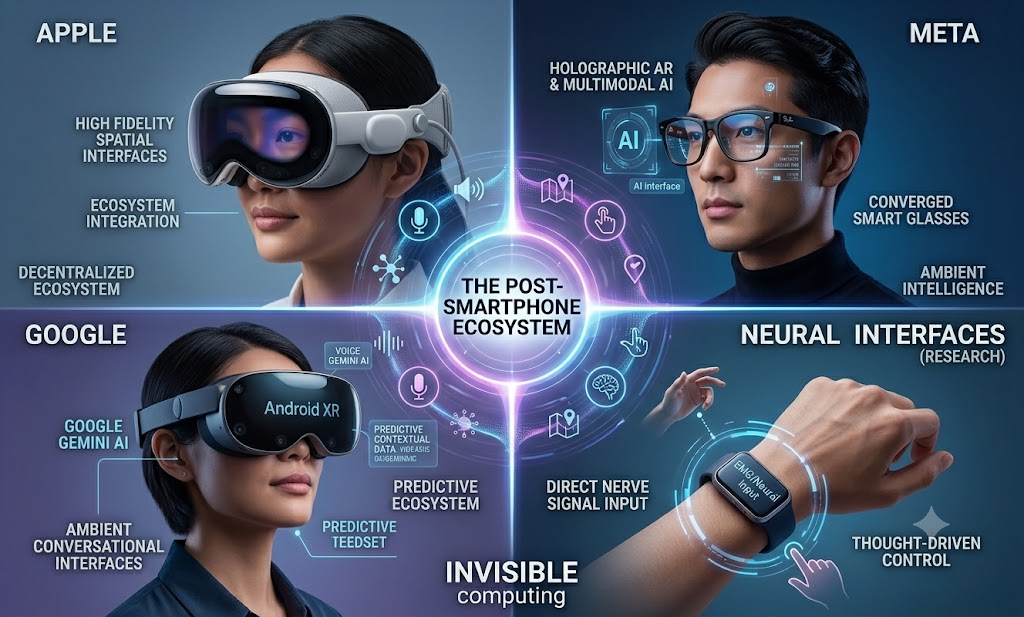
The transition away from mobile form factors relies on three foundational technological pillars. These pillars work in tandem to create an ambient computing environment.
+-----------------------------------------------------------------+
|                    THE POST-SMARTPHONE ECOSYSTEM                |
+-----------------------------------------------------------------+
|                                                                 |
|   [ Spatial Computing ]   -->   [ Ambient AI ]   -->   [ BCI ]  |
|   (AR Glasses/XR Wraps)         (Voice/Context)        (Neural) |
|                                                                 |
+-----------------------------------------------------------------+
|           Result: Invisible, Frictionless Interaction          |
+-----------------------------------------------------------------+
1. Spatial Computing and Augmented Reality (AR)
Spatial computing blends digital content into our physical space. Instead of pulling out a phone to check directions, a digital pathway will be overlaid directly onto the sidewalk in front of you via lightweight AR glasses.
2. Ambient Intelligence and Generative AI
An ambient interface is one that is always present but entirely unobtrusive. As detailed in academic reporting on The Data Scientist, advanced artificial intelligence systems will anticipate your needs based on context, location, and biometrics. Consequently, they will deliver information via audio or minimal visual cues before you even think to ask for it.
3. Brain-Computer Interfaces (BCIs) and Neural Inputs
To eliminate the friction of typing or swiping, tech giants envision a future beyond smartphones driven by alternative input methods. These innovations range from electromyography (EMG) wristbands that read nerve signals to fully implanted brain-computer interfaces. Ultimately, these advanced systems will allow users to control digital environments with mere thought.
How Individual Tech Giants Envision the Future
Every major technology conglomerate approaches the post-smartphone frontier from a unique strategic angle, leveraging their existing strengths in hardware, software, or data infrastructure.
Meta: The Convergence of Smart Glasses and AI
Meta has pivoted aggressively toward spatial computing. Mark Zuckerberg envisions a future where stylish, lightweight AR glasses replace both smartphones and traditional laptops altogether, a sentiment widely detailed across analysis platforms.
“Smart glasses are going to be a compelling form factor because they let you keep your eyes up on the world around you, rather than looking down at a screen. When combined with AI that can see what you see and hear what you hear, they become the ultimate cognitive assistant.”
— Mark Zuckerberg, CEO of Meta
Meta’s partnership with EssilorLuxottica (the owners of Ray-Ban) serves as a critical stepping stone. By embedding multimodal AI into everyday eyewear, they condition users to interact with technology via voice and sight, laying the groundwork for true holographic AR displays.
Apple: Spatial Computing via Ecosystem Luxury
Apple entered the arena with a distinct philosophy: spatial computing must deliver uncompromising fidelity. The Apple Vision Pro represents their initial, high-powered stake in this future.
While the Vision Pro operates as a high-end standalone device, Apple’s ultimate roadmap points toward miniaturization. They aim to shrink this immense spatial processing power into everyday accessories. In fact, industry roadmaps reported by TechRadar suggest Apple is exploring alternative wearable form factors, including a dedicated AI clip or pin device slated for later in the decade, alongside their ongoing AR glass developments.
Google: Ambient AI and the Conversational Interface
Google’s vision focuses less on a specific piece of eyewear and more on the underlying intelligence. They envision a world where Google Gemini is woven into the fabric of your environment. Whether you are speaking to your smart home, wearing audio earbuds, or looking through an Android-powered XR device, Google aims to be the predictive software layer that coordinates your life. This philosophy dates back to their foundational principles of invisible utility, which they regularly document via Google Design initiatives.
Comparative Analysis of Next-Gen Form Factors
| Technology | Primary Input Method | Current Market Status | Expected Mass Adoption | Major Limitation |
| Smart Audio & Earbuds | Voice / Touch | Highly Mature | Current / Ongoing | No visual display capability |
| Smart AR Glasses | Eye Tracking / Gestures | Emerging / Developer | 2028–2030 | Battery life and thermal management |
| Spatial Headsets (MR) | Hand Tracking / Controllers | Niche / Premium | 2026–2028 | Bulky form factor, social isolation |
| Neural/EMG Wristbands | Micro-gestures / Nerve Signals | Research & Development | 2029–2032 | Steep user learning curve |
Pros and Cons of a Post-Smartphone World
Like any sweeping technological revolution, moving past the smartphone brings a complex mix of unprecedented benefits and profound societal challenges.
Pros
-
Enhanced Human Connection: By shifting our gaze upward from screens, we can engage more directly with the people and environments around us.
-
Ergonomic Relief: Eliminating the “text neck” posture caused by constant smartphone use will alleviate widespread physical strain.
-
Frictionless Productivity: Contextual data delivery removes the need to constantly unlock devices, open apps, and sort through notifications manually.
-
Accessibility Breakthroughs: Neural and voice-driven interfaces allow individuals with mobility impairments to navigate the digital world with total autonomy.
Cons
-
Total Loss of Privacy: For AR glasses and ambient AI to function effectively, they must constantly scan, record, and analyze your physical surroundings.
-
Continuous Digital Distraction: Overlaying digital notifications directly onto the physical world could create an inescapable layer of advertising and mental noise.
-
High Barriers to Entry: Early iterations of next-generation hardware will remain prohibitively expensive, widening the digital divide.
-
Severe Battery Constraints: Packing immense processing power into lightweight, socially acceptable eyewear requires battery breakthroughs that do not yet exist.
The Societal and Psychological Impact
Shifting away from mobile screens will fundamentally alter how we perceive reality. As tech giants envision a future beyond smartphones, a permanent digital layer will fuse entirely with our physical surroundings, causing the concept of ‘being online’ to disappear. Instead, we will live in a state of perpetual, augmented connectivity.
This evolution raises critical psychological questions. If two people look at the same street corner but see entirely different digital overlays—tailored to their unique political beliefs, shopping habits, or social networks—the shared, objective physical reality we take for granted could begin to fracture. Consequently, tech giants must design these platforms with strict ethical frameworks to prevent hyper-personalized echo chambers from leaking into our physical neighborhoods.
Timeline to Mass Adoption
The transition will not happen overnight. Instead, it will unfold across three distinct waves over the next decade.
Phase 1: The Hybrid Era (2026–2028)
Smartphones will remain the primary computing hubs, but they will increasingly act as pocket-bound engines powering external accessories. Smart glasses and advanced audio wearables will handle the user interface, offloading heavy processing tasks directly to the phone via high-speed wireless protocols.
Phase 2: The Decoupling (2029–2032)
As edge-computing chips become significantly more efficient and high-speed networks roll out globally, wearable devices will achieve complete independence. Smart AR glasses will feature onboard cellular connectivity, allowing users to leave their smartphones at home without sacrificing functionality.
Phase 3: Total Ambient Integration (2033 and Beyond)
Smartphones will transition into legacy technology, much like the desktop towers of the past. Computing will become fully decentralized, split among smart clothing, biometric jewelry, AR eyewear, and intelligent environments that recognize your presence and adapt to your needs instantly.
Frequently Asked Questions (FAQ)
What exactly does “ambient intelligence” mean?
Ambient intelligence refers to electronic environments that are sensitive and responsive to the presence of people. Specifically, instead of requiring you to actively interact with a device (like opening an app on a phone), ambient technology uses AI, sensors, and contextual data to seamlessly deliver information or adjust parameters in the background without explicit commands.
Will smart glasses completely replace mobile phones?
In the long run, yes. While early generations of smart glasses act merely as accessories that tether to a smartphone for processing power, the ultimate goal of tech companies is to make them entirely standalone. Consequently, once battery, thermal efficiency, and network constraints are solved, a pair of glasses will be able to handle calls, navigation, entertainment, and messaging independently.
How do brain-computer interfaces work as an input method?
To clarify, brain-computer interfaces (BCIs) or advanced electromyography (EMG) wearables don’t actually read your thoughts like science fiction. Instead, they detect the tiny electrical nerve impulses sent from your brain toward your muscles (such as your wrist or fingers). As a result, even an invisible micro-gesture can be translated by an AI engine into a digital command, like clicking a button or scrolling through a menu.
What are the biggest hurdles preventing the post-smartphone shift right now?
Currently, the primary roadblocks are hardware limitations and battery density. Packing spatial computing processors and cellular radios into lightweight, seventy-gram glasses without overheating remains an immense, complex engineering challenge. Ultimately, overcoming this obstacle requires completely new battery chemistry and chip architectures.
Summary and Final Thoughts
The smartphone has served us remarkably well, transforming global society and bringing the sum of human knowledge to our fingertips. However, its form factor remains fundamentally restrictive. As tech giants envision a future beyond smartphones, they design invisible technology that seamlessly dissolves into our daily lives.
By extension, blending spatial computing, predictive artificial intelligence, and natural human inputs allows the next generation of technology to return our eyes to the world around us. Nevertheless, navigating this transition successfully will require rigorous attention to data privacy, hardware ergonomics, and digital well-being. In conclusion, if executed responsibly, the post-smartphone era will not isolate us further; instead, it will humanize technology, making our digital interactions more natural, intuitive, and integrated than ever before.
Source: Brera