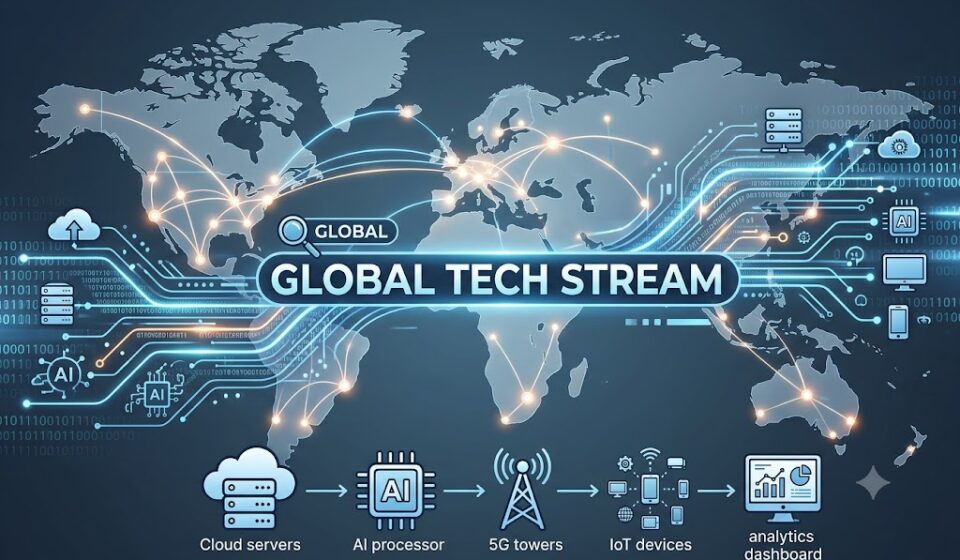
The Global Tech Stream has evolved from a futuristic concept into the primary engine driving modern enterprise transformation. As organizations worldwide face unprecedented pressure to modernize, understanding this continuous flow of interconnected technological advancements is no longer optional. It represents the fluid integration of artificial intelligence (AI), cloud computing, edge networks, and advanced automation into a single, cohesive ecosystem. Businesses that successfully tap into this current can achieve unprecedented agility, while those that ignore it risk immediate irrelevance.
Consequently, navigating this shifting landscape requires a strategic roadmap. This comprehensive guide explores the core components of the global tech stream, analyzes its benefits and challenges, and provides actionable insights for tech leaders aiming to leverage its momentum.
The Core Pillars of the Global Tech Stream
To understand the global tech stream, one must first examine the foundational technologies that feed into it. It is not a single software or isolated trend; rather, it is the convergence of several high-octane innovations working in tandem.
1. Artificial Intelligence and Autonomous Systems
AI acts as the predictive brain of the entire ecosystem. From machine learning algorithms that optimize supply chains to generative AI models that automate content creation, intelligent systems process vast amounts of data at lightning speed.
2. Hyper-Scale Cloud Infrastructure
The cloud serves as the scalable backbone. Without the storage and computational capacity provided by hyper-scalers, processing the massive data loads generated by global operations would be functionally impossible.
3. Edge Computing and the Internet of Things (IoT)
While the cloud centralizes processing power, edge computing pushes data handling closer to the actual source. This reduction in latency allows autonomous vehicles, smart factories, and medical devices to make split-second decisions without waiting for a distant server to respond.
Comparative Analysis of Stream Technologies
Different industries prioritize different facets of the tech ecosystem. The table below outlines how key components match up against critical business metrics like implementation velocity, scalability, and security risk.
| Technology Component | Implementation Velocity | Scalability Potential | Primary Security Risk |
| Generative AI & ML | Medium | High | Data privacy & IP leakage |
| Cloud-Native Infra | Fast | Hyper-Scale | Misconfigured APIs |
| Edge Computing | Slow | Medium to High | Physical device tampering |
| Blockchain Ledgers | Slow | Medium | Smart contract vulnerabilities |
Market Dynamics: Drivers and Restraints
“The global tech stream is not a destination; it is a continuous state of evolution. Companies must shift from building rigid systems to designing fluid architectures that adapt to data in real time.”
— Dr. Aris Thorne, Chief Innovation Officer at Nexus Tech Labs
The momentum behind this digital shift stems from a mix of consumer demand and operational necessity. However, several significant roadblocks still hinder universal adoption.
The Accelerators (Pros)
-
Hyper-Efficiency: Automation removes human error from repetitive tasks, saving thousands of operational hours.
-
Data-Driven Decision Making: Real-time analytics eliminate guesswork, allowing executives to pivot strategies based on concrete numbers.
-
Global Accessibility: Cloud-based systems ensure that distributed workforces can collaborate seamlessly from any geographical location.
The Friction Points (Cons)
-
Integration Complexity: Legacy systems often resist integration with modern API-driven architectures, creating costly bottlenecks.
-
The Talent Chasm: The demand for cloud architects, AI engineers, and cybersecurity specialists far outpaces the available talent pool.
-
Escalating Cyber Threats: A more connected ecosystem naturally expands the attack surface for malicious actors, necessitating robust zero-trust security frameworks.
Deep Dive: Pros and Cons Matrix
To help your organization weigh the strategic trade-offs of deep integration, consider this structured look at the advantages and challenges inherent in the current tech landscape.
Pros
-
Enhanced Agility: Enables rapid deployment of new software features and consumer applications.
-
Cost Optimization: Shifts capital expenditure (CapEx) to operational expenditure (OpEx) via pay-as-you-go cloud models.
-
Customer Personalization: Leverages predictive analytics to tailor user experiences individually and at scale.
Cons
-
Vendor Lock-In: Migrating heavy workloads away from dominant cloud providers can incur massive egress fees.
-
Regulatory Compliance: Navigating international data laws like GDPR and CCPA becomes incredibly complex across a global network.
-
High Initial Investment: Upfront costs for consulting, refactoring legacy code, and training staff can strain short-term budgets.
Industry Case Studies: The Stream in Action
Looking at theoretical benefits is valuable, but real-world execution proves the true power of the global tech stream.
Logistics and Supply Chain
A multinational shipping enterprise integrated IoT sensors across its entire fleet, routing the data directly into a cloud-based AI analytics engine. As a result, the company reduced fuel consumption by 14% through dynamic route optimization and predicted mechanical failures two weeks before they occurred on the open sea.
Financial Services and FinTech
Legacy banking institutions are rapidly adopting cloud-native microservices to compete with agile FinTech startups. By migrating their core banking systems to decentralized, secure cloud streams, these institutions can process cross-border transactions in milliseconds rather than days, drastically improving customer satisfaction.
Strategic Steps for Implementation
If your organization wants to successfully ride the global tech stream, you cannot rely on ad-hoc IT upgrades. You must implement a deliberate, multi-phase strategy.
[Assess Legacy Infrastructure] ➔ [Establish Zero-Trust Security] ➔ [Upskill the Internal Workforce]
-
Audit the Current Stack: Identify which legacy systems are salvageable through APIs and which require complete decommissioning.
-
Prioritize Security First: Do not treat security as an afterthought. Implement a zero-trust architecture before migrating workloads to the cloud.
-
Cultivate a Continuous Learning Culture: Invest heavily in upskilling programs. Your technology is only as powerful as the team operating it.
“Organizations that view upskilling as an expense rather than an investment will inevitably find themselves choked out of the tech stream by more agile competitors.”
— Sarah Jenkins, Author of ‘The Cloud-Native Enterprise’
Future Horizons: What Lies Beyond the Horizon?
As we peer further into the decade, the global tech stream will likely merge with emerging frontiers like quantum computing and spatial computing. Quantum algorithms will soon solve optimization problems that would take classical supercomputers millennia to compute. Simultaneously, the refinement of augmented and virtual reality interfaces will change how humans interact with these complex streams of data, turning abstract metrics into immersive, spatial workspaces.
Furthermore, environmental sustainability will dictate future engineering choices. Green data centers, powered entirely by renewable energy sources, are becoming the standard as enterprises strive to meet strict ESG (Environmental, Social, and Governance) targets while expanding their digital footprints.
Frequently Asked Questions (FAQ)
What exactly is the Global Tech Stream?
The Global Tech Stream refers to the continuous, fluid integration of advanced technologies—such as artificial intelligence, cloud infrastructure, and edge computing—into a singular, interconnected global ecosystem. Rather than viewing IT upgrades as isolated events, forward-thinking organizations treat this stream as a dynamic operational standard. Consequently, businesses can seamlessly capture, process, and act on global data in real time.
How does the tech stream impact small to medium enterprises (SMEs)?
Initially, deep integration might seem exclusive to tech giants; however, scalable cloud architectures have completely leveled the playing field. SMEs can now leverage enterprise-grade AI algorithms and global distribution networks on a pay-as-you-go basis. By systematically adopting these tools, smaller businesses can outmaneuver rigid, legacy-bound corporations with superior market agility.
What are the biggest security risks associated with data streams?
Because a unified data stream expands an organization’s digital footprint, it naturally increases the potential attack surface for cybercriminals. The most prevalent vulnerabilities include misconfigured cloud APIs, data privacy leaks within generative AI models, and physical device tampering at the edge network level. Therefore, deploying a strict Zero-Trust Security Framework must remain a non-negotiable priority during implementation.
How can companies address the growing tech talent shortage?
To combat the ongoing talent chasm, businesses must transition away from purely external hiring strategies. Instead, successful enterprises invest heavily in internal upskilling programs and utilize low-code/no-code automation platforms. This strategic pivot empowers your existing workforce to manage complex workflows without requiring a massive team of specialized engineers.
What is the role of sustainability within the Global Tech Stream?
As data volumes surge globally, the energy consumption of massive server networks faces intense scrutiny. To mitigate this impact, the tech stream is rapidly pivoting toward green data centers powered entirely by renewable energy. Ultimately, matching technological expansion with strict ESG (Environmental, Social, and Governance) compliance ensures that digital growth does not come at the expense of the planet.
Final Verdict
The Global Tech Stream represents an unstoppable shift in how the world conducts business. While the challenges of cybersecurity risks, rising implementation costs, and talent shortages are real, the penalties for inaction are far more severe. By systematically upgrading infrastructure, embracing automated intelligence, and fostering an adaptable corporate culture, modern enterprises can successfully harness this digital current to drive sustained growth, efficiency, and market leadership for years to come.