In the rapidly evolving landscape of modern healthcare, the role of a CT tech stands out as a vital diagnostic bridge. Consequently, these specialized medical imaging professionals utilize advanced X-ray equipment to capture detailed, cross-sectional views of the human body. By translating complex internal structures into digital images, they provide physicians with critical clarity needed to diagnose complex trauma. Therefore, for anyone searching for a high-impact healthcare career, understanding the educational pathways of computed tomography is a perfect start. To explore more about how modern medical advancements intersect with professional training, you can read more at TechnologyMalt.
What is a CT Tech? Roles and Responsibilities
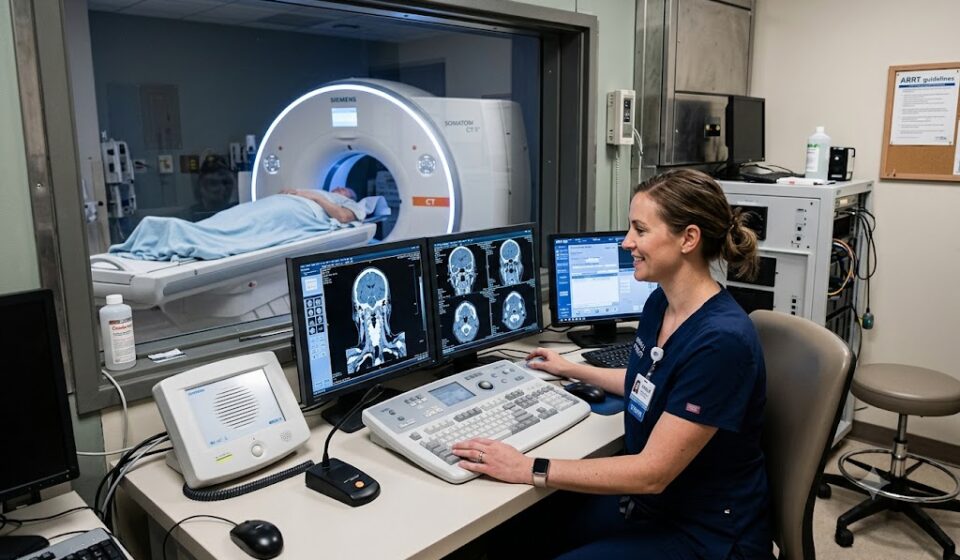
Essentially, a CT technologist is a certified professional who has undergone advanced training to operate complex computed tomography scanners. Unlike traditional X-rays, which produce flat, two-dimensional images, CT scanners continuously rotate a motorized X-ray source around patients. Meanwhile, a computer rapidly compiles these data layers into incredibly precise, three-dimensional digital slices for medical review.
Core Daily Responsibilities
Because the daily schedule is fast-paced, a professional must efficiently perform several core clinical and technical duties:
-
Patient Preparation: First, they verify identity, review medical history, screen for contraindications, and explain the scanning process thoroughly.
-
Administering Contrast Material: Next, they carefully prepare and administer oral or intravenous contrast media to enhance internal anatomical visibility.
-
Equipment Operation: Furthermore, they position patients precisely on motorized tables and program correct protocols into the computer console.
-
Radiation Safety: Meanwhile, they implement strict ALARA protocols, utilize lead shielding, and modulate dose settings to protect everyone.
-
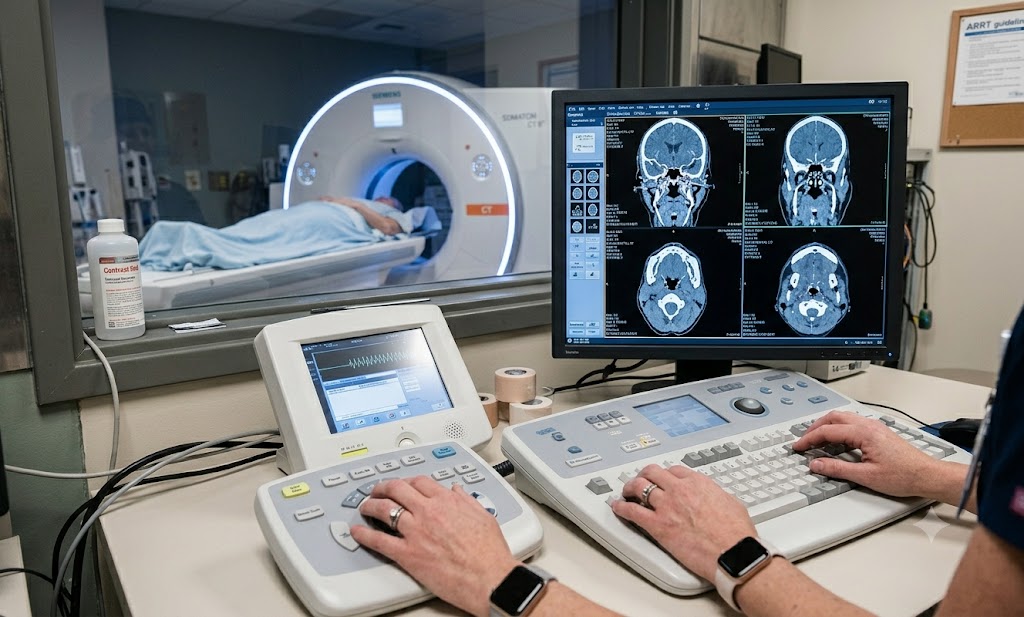
Image Quality Control: Finally, they monitor real-time scans, review slices for clarity, and transfer data directly to PACS.
“A great CT technologist doesn’t just push buttons on a multi-million dollar machine. They master the delicate balance between physics, patient comfort, and rapid-fire clinical problem-solving under immense pressure.”
— Sarah Jenkins, RT(R)(CT), Clinical Imaging Director
The Evolution of Computed Tomography Technology
To fully appreciate this modern medical role, it helps to understand how far scanning technology has historically come. Early scanners took hours to acquire single slices, whereas today’s ultra-fast machines can scan entire organs in milliseconds.
[1970s: Single-Slice Scanners] ➔ [1990s: Helical/Spiral CT] ➔ [2000s: Multi-Slice CT (64+)] ➔ [Present: Dual-Source & Photon-Counting CT]
Key Technical Milestones
-
Axial Scanners (1970s): Initially, these systems acquired data step-by-step, requiring the patient table to move and stop sequentially.
-
Helical/Spiral CT (1990s): Subsequently, continuous tube rotation allowed the table to glide smoothly, which vastly reduced patient scan times.
-
Multi-Slice CT (MSCT): Later, advanced arrays of multiple detectors shifted system capabilities from 4-slice configurations up to 320-slice options.
-
Photon-Counting CT: Ultimately, this newest technological frontier offers unprecedented spatial resolution at significantly lower patient radiation doses.
Pros and Cons of Becoming a CT Technologist
Choosing this career path requires a clear-eyed look at both the financial rewards and the inherent workplace challenges.
Pros Explained
-
High Demand: First, an aging population and growing reliance on non-invasive diagnostics ensure incredibly steady long-term employment options.
-
Competitive Salary: Additionally, specialized technologists earn significantly higher compensation than entry-level, general diagnostic radiographers.
-
Fast-Paced Environment: Finally, emergency room traumas and urgent stroke protocols ensure that clinical days are never boring or identical.
Cons Explained
-
Physical Demands: Conversely, technologists spend hours standing, lifting immobile patients, and manipulating heavy mechanical imaging equipment daily.
-
Shift Work: Furthermore, hospitals operate around the clock, meaning night shifts, weekends, and mandatory on-call rotations are standard.
-
High-Stress Situations: Alternatively, managing critically injured patients or individuals experiencing severe panic requires immense emotional intelligence.
Comparative Analysis: Pros vs. Cons
| Advantages of a CT Tech Career | Challenges of a CT Tech Career |
| Strong financial compensation and premium shift differentials | Physical strain from patient transfers and long periods of standing |
| Accelerated pathway into the profession (often 1–2 years post-radiography) | High exposure to stressful emergency room traumas and critical care cases |
| Continuous interaction with cutting-edge medical software and AI | Potential for burnout due to erratic night, weekend, and holiday schedules |
| Direct, impactful contribution to life-saving medical diagnoses | Strict adherence to radiation safety and chemical handling protocols |
How to Become a CT Tech: Educational and Certification Pathway
Breaking into computed tomography requires a structured educational approach, hands-on clinical training, and professional national credentialing.
Step 1: Earn Degree in Radiologic Technology (Associate/Bachelor's)
                          ▼
Step 2: Pass ARRT Registry Exam for Radiographer designation: RT(R)
                          ▼
Step 3: Complete Clinical CT Competency Hours & Structured Education
                          ▼
Step 4: Pass ARRT (CT) Post-Primary Examination
                          ▼
Step 5: Maintain State Licensure and Continuing Education (CE) Credits
Educational Prerequisites
Before specializing in advanced CT, candidates must establish a foundational background by enrolling in accredited radiologic technology programs. These programs, which award associate or bachelor’s degrees, cover human anatomy, patient care ethics, and fundamental radiation physics. For comprehensive guidance on structural tech certifications, review the career development resources available on TechnologyMalt.
Certification and Credentialing
Upon graduation, candidates must pass the primary national registry exam administered by the ARRT to earn credentials. Afterward, licensed radiographers can pursue post-primary certification by documenting specific clinical competencies and passing the dedicated ARRT(CT) exam.
CT Tech Salary Expectations and Job Outlook
The financial rewards for pursuing this specific career are among the most attractive within allied health professions.
Salary Variables
However, total compensation varies significantly based on geographic location, years of clinical experience, and specific facility types. For instance, travel CT techs take short-term contracts across the country and command the highest premium compensation packages.
Industry Growth Data
| Employment Metric | Current Industry Standard & Outlook |
| Median Annual Salary | $78,000 – $88,000+ (Varies heavily by state) |
| Hourly Pay Range | $35.00 – $52.00 / hour |
| Projected Job Growth (2024–2034) | ~6% (Faster than average for all occupations) |
| Top-Paying Environments | Outpatient Care Centers & Specialty Surgical Hospitals |
Advanced Skills and Technological Innovations in CT
The responsibilities of a modern tech stretch far beyond basic patient positioning or clicking buttons on a console.
Artificial Intelligence Integration
Importantly, AI is rapidly changing how daily workflows are managed. Modern scanners utilize deep-learning algorithms to automate positioning, calculate low radiation doses, and flag urgent findings for immediate radiologist review.
Advanced Imaging Protocols
-
CT Angiography (CTA): Specifically, this protocol provides detailed mapping of arterial systems to identify aneurysms or blockages.
-
Cardiac Gating: Additionally, synchronizing scans with electrocardiograms captures crystal-clear images of coronary arteries without motion blur.
-
Perfusion Imaging: Consequently, measuring blood flow through brain tissue helps determine salvageable areas during acute stroke alerts.
A Day in the Life of a CT Technologist
To understand what makes this career unique, consider a typical afternoon inside a busy Level 1 trauma center.
The shift begins with a meticulous calibration check of the scanner. Within minutes, an emergency alert signals the arrival of a severe motor vehicle accident victim. Immediately, the tech coordinates with nurses, transfers the patient, verifies spinal alignment, and runs a rapid scan.
While processing those critical images, an outpatient arrives for a routine oncology scan. Therefore, the technologist switches gears completely, demonstrates exceptional empathy, establishes an IV line, and carefully administers contrast. This constant shifting between high-intensity trauma and calm care truly defines the entire profession.
Essential Skills for Success in Computed Tomography
Technical proficiency is only half of the equation because exceptional soft skills are equally critical for patient outcomes.
-
Clinical Communication: Clearly explaining intimidating procedures to fearful patients or individuals with cognitive impairments is vital.
-
Spatial Awareness: Understanding cross-sectional spatial geometry helps technicians accurately calculate contrast volume dosages and scanning delays.
-
Interdisciplinary Teamwork: Working closely with emergency physicians, nurses, and radiologists ensures diagnostic imaging pathways remain efficient.
Helpful Video Overview of CT Technology
For a visual look into how these systems operate, check out this educational video detailing computed tomography:
Related Instructional Video
Please watch this detailed breakdown of how medical scanners capture cross-sectional anatomical slices:
Understanding Computed Tomography (CT) Scanning and Technology
Frequently Asked Questions (FAQ)
What is the difference between an X-ray tech and a CT tech?
An X-ray tech captures static 2D images. Conversely, a CT tech operates a rotating gantry to capture 3D slices.
How long does it take to become a certified CT tech?
Generally, the process takes two to three years of combined undergraduate education, radiography credentialing, and specialized clinical training.
Do CT techs face a high risk of radiation exposure?
No, because they operate equipment from separate, heavily lead-shielded control rooms, keeping personal operational exposure exceptionally low.
Is the CT registry exam difficult to pass?
Yes, the exam is notoriously rigorous, requiring a thorough grasp of cross-sectional anatomy, advanced imaging physics, and safety.
Can a CT technologist work from home?
Typically no, because the role requires hands-on patient care, contrast administration, and physical management of heavy medical equipment.
Content Referral & Reference Links
-
Internal Tech Insights: Find additional articles on medical software evolution and workforce updates directly at TechnologyMalt.
-
National Credentialing & Certification: Learn about the formal certification standards on the American Registry of Radiologic Technologists (ARRT) official portal.
-
Professional Development & Education: Explore continuing education resources through the American Society of Radiologic Technologists (ASRT).
-
Program Accreditation: Verify accredited imaging programs across the country via the Joint Review Committee on Education in Radiologic Technology (JRCERT).
-
Industry Salary & Job Outlook Data: Review updated employment statistics on the U.S. Bureau of Labor Statistics (BLS) handbook.
-
Advanced Computed Tomography Research: Read peer-reviewed medical studies at the Radiological Society of North America (RSNA).